
Last updated on
Oct 31, 2026

CA SC-6021 - Santa Barbara 2021-2026 free printable template
pdfFiller is not affiliated with any government organization

Fill out
Complete the form online in a simple drag-and-drop editor.

eSign
Add your legally binding signature or send the form for signing.

Share
Share the form via a link, letting anyone fill it out from any device.

Export
Download, print, email, or move the form to your cloud storage.
Why pdfFiller is the best tool for your documents and forms


End-to-end document management
From editing and signing to collaboration and tracking, pdfFiller has everything you need to get your documents done quickly and efficiently.
Accessible from anywhere
pdfFiller is fully cloud-based. This means you can edit, sign, and share documents from anywhere using your computer, smartphone, or tablet.
Secure and compliant
pdfFiller lets you securely manage documents following global laws like ESIGN, CCPA, and GDPR. It's also HIPAA and SOC 2 compliant.
What is CA SC-6021 - Santa Barbara
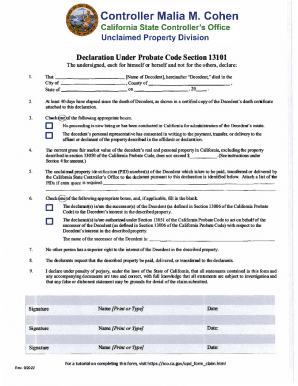
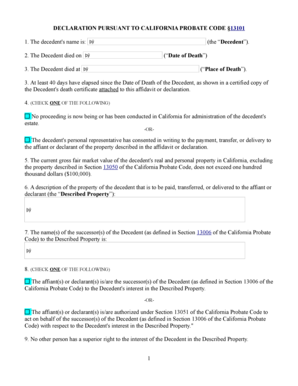
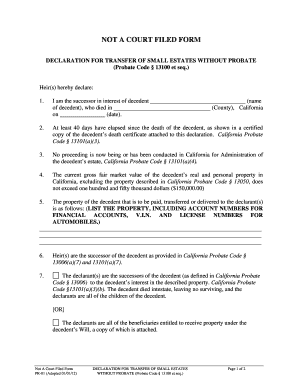
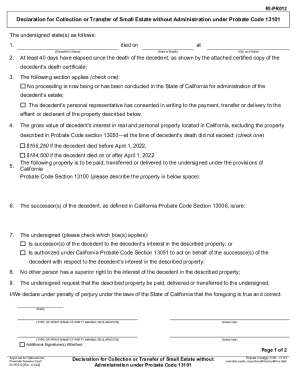
The California Probate Code Declaration is a legal document used by heirs to claim property from a decedent's estate in California when no probate proceedings are ongoing.
pdfFiller scores top ratings on review platforms




Who needs CA SC-6021 - Santa Barbara?
Explore how professionals across industries use pdfFiller.

CA SC-6021 - Santa Barbara is needed by:
-
Individuals claiming property from a deceased relative's estate
-
Heirs of a decedent with small estate value
-
Legal representatives handling estate matters
-
Estate administrators and executors
-
Trustees managing decedent's assets
-
Attorneys specializing in estate planning
Comprehensive Guide to CA SC-6021 - Santa Barbara
What is the California Probate Code Declaration?
The California Probate Code Declaration is a legal document used within the realm of estate law specifically aiming to claim property from a decedent's estate. This declaration serves to streamline the process for heirs and beneficiaries when the estate's total value falls below a predetermined threshold, and traditional probate proceedings are bypassed. The declarant plays an essential role, as they must provide accurate details about their relationship to the decedent and the property in question.
Purpose and Benefits of the California Probate Code Declaration
This document is particularly necessary for small estates, as it helps simplify the property claim process, ensuring that heirs and beneficiaries can access their rightful inheritances without facing prolonged probate complications. By utilizing the California Probate Code Declaration, individuals can avoid the extensive time and costs often associated with full probate proceedings. This not only expedites access to assets but also reduces the overall burden on the estate.
Who Needs the California Probate Code Declaration?
Heirs and beneficiaries are among those who may need to utilize this form to claim property from a decedent's estate. Circumstances that necessitate the declaration include situations where the deceased's total estate value qualifies, and no active probate is underway. Filing this document carries significant legal implications, ensuring that rightful claimants can assert ownership in accordance with California estate law.
Key Features of the California Probate Code Declaration
The structure of the California Probate Code Declaration is designed with clarity and practicality in mind, featuring fillable fields and checkboxes. Key information required includes the decedent's particulars, the claimant's relationship to the decedent, and any relevant property details. Importantly, the form must be signed under penalty of perjury, underscoring the necessity for accuracy in declarations.
How to Fill Out the California Probate Code Declaration Online (Step-by-Step)
Filling out the California Probate Code Declaration online using pdfFiller is straightforward. Follow these steps to ensure proper completion:
-
Access pdfFiller and upload the California Probate Code Declaration form.
-
Fill in all required fields, including decedent details and your relationship.
-
Attach any necessary supporting documentation as prompted.
-
Review the form for accuracy, ensuring all sections are completed properly.
-
Sign the form electronically to certify under penalty of perjury.
Make sure to double-check your entries to avoid common mistakes that could delay processing.
Review and Validation Checklist for the California Probate Code Declaration
Before submitting the California Probate Code Declaration, it's critical to review it thoroughly. Here are common errors to watch out for:
-
Incomplete or missing information in required fields.
-
Incorrect relationships stated between the declarant and the decedent.
-
Failure to sign the form where indicated.
Utilizing pdfFiller tools can aid in editing and validating the document, ensuring it meets all necessary requirements prior to submission.
Submission Methods for the California Probate Code Declaration
Once completed, the California Probate Code Declaration can be submitted through a variety of methods. Options include online submission or delivering the form in person to the appropriate local probate court. Be mindful of important submission deadlines, associated fees, and anticipated processing times to avoid unnecessary delays. Tracking the submission status is also advisable to ensure everything is on course.
What Happens After You Submit the California Probate Code Declaration?
After submission, you may anticipate several possible outcomes. The court will typically notify you regarding the receipt of your declaration, confirming that it has been filed. If any amendments or corrections are necessary, instructions will be provided. Understanding common rejection reasons can also help in addressing potential issues early in the process.
Privacy and Data Security When Using the California Probate Code Declaration
pdfFiller prioritizes user privacy and data security, employing robust measures to protect sensitive information. The platform adheres to industry-leading encryption standards and maintains compliance with regulations such as HIPAA and GDPR. Users can feel secure knowing their personal data is safeguarded throughout the declaration process.
Elevate Your Experience with pdfFiller for the California Probate Code Declaration
Utilizing pdfFiller enhances the experience of completing the California Probate Code Declaration with its range of features designed for user convenience. The cloud-based platform allows for easy filling, signing, and managing of legal documents. User satisfaction is reflected in testimonials and high engagement levels, underscoring pdfFiller's commitment to providing an effective document management solution.
How to fill out the CA SC-6021 - Santa Barbara
-
1.To access the California Probate Code Declaration on pdfFiller, begin by visiting the pdfFiller website. Use the search bar to type 'California Probate Code Declaration' and select the relevant form from the results.
-
2.Once the form is open, locate the fillable fields within the document. pdfFiller's interface allows easy navigation—click on the fields to input details directly.
-
3.Before you start filling out the form, gather necessary information such as the decedent's full name, date of death, details about the property being claimed, and your relationship to the decedent.
-
4.As you complete the form, ensure accuracy in every field to avoid errors that may delay the process. Review instructions provided on pdfFiller to guide you through each section.
-
5.After filling out all fields, take a moment to review the completed form for any mistakes or missing information. Ensure all required sections are adequately filled.
-
6.To finalize your California Probate Code Declaration, use pdfFiller's tools to save the document. You can choose to download it directly to your device or submit the form according to specific requirements.
-
7.If you need to submit the form, follow any local guidelines for submission, which may include mailing or delivering it to the appropriate county authority.

Who is eligible to file the California Probate Code Declaration?
To use the California Probate Code Declaration, you must be an heir or individual authorized to claim property from a decedent's estate where the estate value is below the specified threshold.
Is there a deadline for submitting this form?
While there is no specific deadline for submitting the California Probate Code Declaration, it should be filed as soon as possible to ensure timely access to the properties claimed.
How do I submit the completed declaration?
The completed California Probate Code Declaration can typically be submitted by mailing or delivering the form directly to the probate court or county clerk's office in the jurisdiction where the decedent resided.
What supporting documents are required with this form?
Along with the California Probate Code Declaration, you may need to provide supporting documents such as a copy of the decedent's death certificate and proof of your relationship to the decedent.
What are common mistakes to avoid when filling out this form?
Common mistakes include incomplete fields, inaccuracies regarding the decedent's information, and failing to sign the form under penalty of perjury. Double-check all details before submission.
How long does it take for the California Probate Code Declaration to be processed?
Processing times for the California Probate Code Declaration can vary based on the jurisdiction, but typically, you can expect a response within a few weeks after submission.
Does the California Probate Code Declaration need to be notarized?
No, the California Probate Code Declaration does not require notarization. However, it must be signed by the declarant under penalty of perjury.
CA SC-6021 - Santa Barbara Form Versions
Related Content
Related Forms



Get the latest insights from our blog


If you believe that this page should be taken down, please follow our DMCA take down process
here
.
This form may include fields for payment information. Data entered in these fields is not covered by PCI DSS compliance.